When Ken Ehrman's niece's rescue dog Ruby got out of an invisible fence and was hit by a car, he says a light bulb went off. Ehrman was not planning to start another company. He had just left I.D. Systems, the asset-tracking business he spent almost 21 years building, and was consulting, with, as he puts it, a great situation. That loss led him to start Halo Collar, a GPS dog collar that, by his own estimate, will do close to $140 million in sales this year.
In this episode of Starting Small, Ehrman, CEO of Halo Collar, walks through the whole arc: a childhood spent on his father's sales trips, a first contract with the U.S. Postal Service, a 1999 IPO, and a second act that began with a family tragedy.
This is the Ken Ehrman founder story, and the origin of Halo Collar, as he told it on the show.
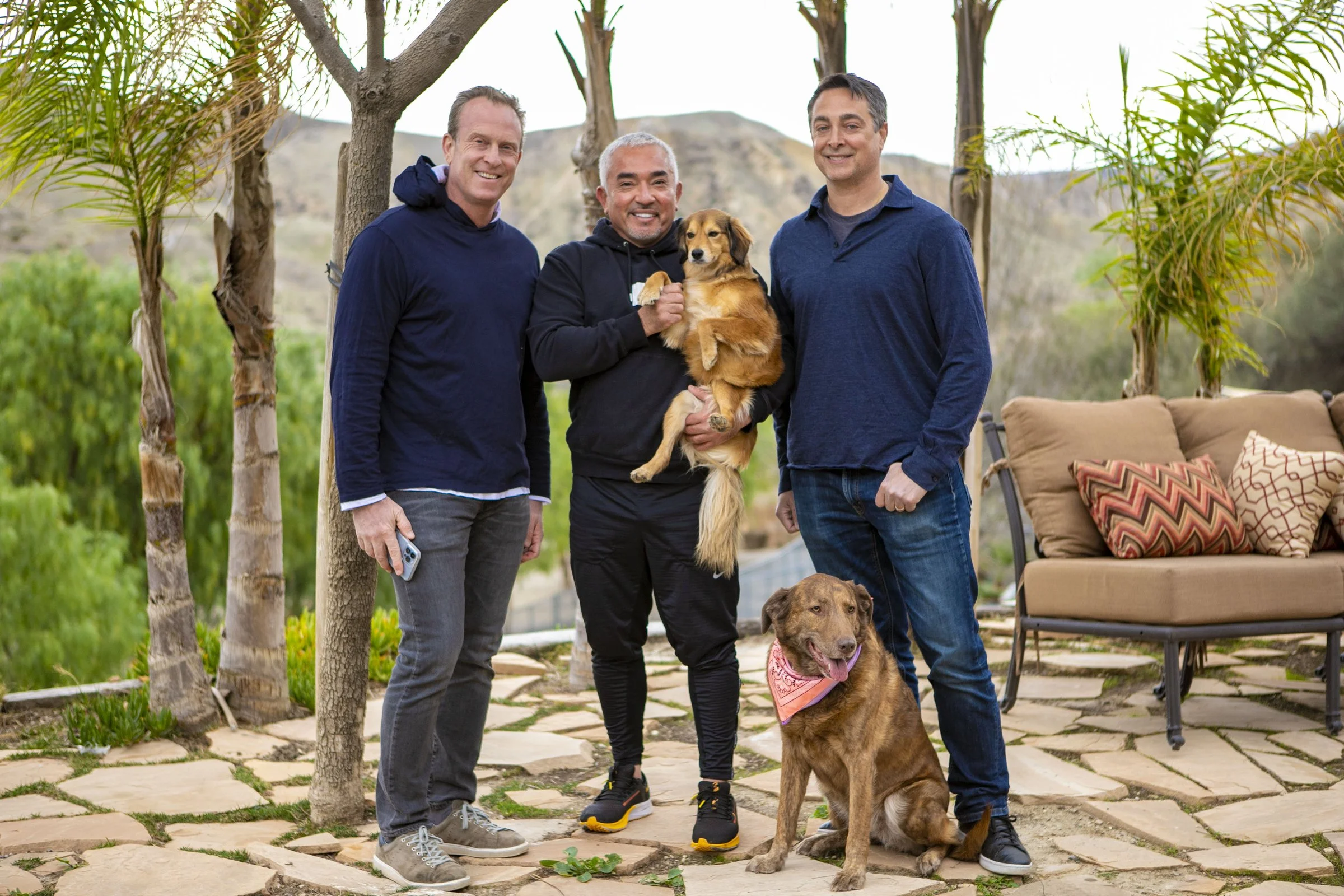
Ken Ehrman (left) with Cesar Millan and Michael Ehrman. Photo: Halo Collar (via Entrepreneur.com)
Listen to the full episode: Starting Small on Apple Podcasts and Podbean
Key takeaways from Ken Ehrman
He learned sales by watching. Ehrman says his father, who sold lace and embroidery, brought him along on sales trips at 10 and 12 to sit in conference rooms and listen.
Government R&D can be non-dilutive. Ehrman says the U.S. Postal Service funded development of technology he could later sell to other customers, without giving up equity.
Find a buyer who wants it as much as you do. His rule for pilots: look for someone at the customer who wants to buy as badly as you want to sell.
Halo started with a search term. Ehrman says roughly 500,000 monthly searches for "invisible fence," at a starting price he puts at $3,500, told him the demand was real.
Be where customers already buy. He says that is how he defines omnichannel.
Recurring revenue changed the math. Ehrman says monthly recurring revenue went from $2.7 million in February to $3.8 million at the time of recording.
His advice: work with someone who has been through it before.
A kid in the conference room
Ehrman grew up in a small community in New York. His father owned his own business, and a neighbor was an entrepreneur and an engineer. His father sold lace and embroidery, "not something I necessarily knew anything about," Ehrman says, but he would bring his son along to prospect meetings when Ehrman was 10 and 12. He loved sitting in those conference rooms listening and learning, and he describes himself as almost a traveling salesman from the start.
He says he always knew he wanted to start a company, and that a great college was part of the plan. He says the expectation at the time was to be extremely well-rounded. He loved mock trial and led his school's yearbook, raising money from local businesses to publish it. He ended up at Stanford, where, he says, being around people who had started companies before they arrived only fed the drive.
Stanford did not offer a business degree, so Ehrman studied industrial engineering, which he describes as engineering management: one-third finance, one-third operations and one-third accounting, plus classes across mechanical, electrical and civil engineering. The lesson, he says: perfection is the enemy of good enough.
Echelon and the smart RFID tag
In 1987 Ehrman joined Echelon in Palo Alto, a classic Silicon Valley company with roller hockey at lunch. He says it was founded by one of Apple's founders, with a vision of being the smart chip inside everything but a computer. It was probably way too early, he says; there was no internet yet to connect those chips.
He left to build that chip into an RFID tag with his neighbor, an executive at a publicly traded lithium battery company. Everyone else was trying to make tags cheaper. Ehrman's pitch was to make them smarter, so the return on investment would outweigh the cost.
There was one problem. "We didn't even know what we were gonna do with it," he says. So they searched. He describes reading the Commerce Business Daily, a thick daily book of what the government wanted to buy. After almost nine months, they found someone at the U.S. Postal Service who wanted to track letters along the route, not just at drop-off and delivery, to find the bottlenecks.
Tracking letters through the mail
Ehrman says the Postal Service was paying management based on on-time delivery, yet mail often ran late and nobody knew why. His team built a circuit card that could ride through the sorting equipment, with readers around each building, so they could see where a test letter was at any moment.
What they found, he says, was revealing. Because pay depended on on-time delivery, someone loading a truck might pull another person's mail off to fit their own. And mail that reached the inbound dock after the early-morning cutoff missed the same-day trucks. According to Ehrman, the contract grew from about a million dollars to close to $40 million as it expanded nationwide.
Letting the government fund the R&D
Ehrman says a contract manufacturer called SCI, which had a government division, teamed with his company and invested in development. The government funded millions of dollars of R&D for a system that did not yet exist.
Here is the part he values most. A commercial customer like Walmart or GM that pays for development usually wants to own it, he says. The government only requires a royalty-free right to use it, so he could sell the same technology to others and keep the profit. "Your R&D just got funded by the U.S. government," he says, without diluting founders and investors.
A manager at a Postal Service facility then asked whether the tags could track forklifts. Drivers do not carry keys, the manager explained, so anyone can drive one, and after an accident nobody is accountable. Ehrman wrote a short letter to almost all the Fortune 100 companies he knew, and several replied, which is how he knew it had value. He says Ford and GM eventually helped develop it.
The free pilot trap
Everyone wants a free pilot, Ehrman says, and it is the conundrum of every entrepreneur. He wants to hear, beforehand, the next steps, the budget, the timing and the success criteria. Too often the customer will not answer, and the founder does it anyway. In his experience, that is not a good idea.
Big companies have inertia, he says, so you need someone inside who wants what you sell as much as you want to sell it. The Postal Service engineer was that person. "You have to find someone who loves what you're doing as much as you do," Ehrman says, and in his experience that approach led to the most successful pilots, rollouts and expansions.
Going public in 1999
I.D. Systems went public in 1999, at the height of the dot-com bubble. Ehrman says the stock was priced at $7 and closed around $7.50, and that an interviewer, he thinks on MSNBC, asked whether he was disappointed. He wasn't: the company had raised millions, he says. Looking back, he calls it probably too early.
He says he was there from 1995 through 2016, almost 21 years, and that the public years brought pressure, politics and bureaucracy. He did not like how boards shifted from major investors to independent directors with little to lose, so Halo, he says, has no board of directors.
From a lost dog to Halo Collar
When Ehrman left I.D. Systems he was consulting and not planning another company. Then his niece's dog Ruby, rescued a year earlier, got out of an invisible fence and was killed by a car. Within days, he says, he saw that the invisible fence was the last wired technology still in use.
He explains the problem simply. A real fence on a half-acre yard can run $10,000 to $20,000, he says, and a dog can still dig or jump out. An invisible fence is a wire under the ground that talks to a collar; when the dog nears the boundary, the collar beeps and then shocks. Dogs learn the boundary, but they also learn they can withstand a second of pain, and once they cross the line they are out.
GPS, he says, is different, because there is no out. The owner draws the boundary on a phone app, and it is downloaded to the collar. The dog can roam within it, but as it approaches the edge the collar beeps, then adds vibration, then adds static, which he compares to the shock from touching a doorknob after walking across a carpet, "like a hundred times less powerful" than the old systems. As soon as the dog stops or turns, the correction stops. He says that, today, Halo dogs hear that beep and turn around about 12 million times a month.
Thinking big while starting small
Ehrman started Halo in 2018, and his bar was world class from day one. He wanted Cesar Millan as his partner because the technology had to be the best, and "who better than someone who really understands dogs instinctively?" Ehrman wanted the best in the world, since the goal was keeping millions of dogs safe.
The same instinct applied to the name. Someone already held the trademark for Halo Collar, he says, and he borrowed $250,000 to buy it.
Technology carried over from his earlier work. His earlier tracking work carried over, but with his brother as technology lead, it still took two and a half years to develop.
Launching online, then in stores
Halo launched only online and only direct to consumer, and Ehrman says that was deliberate. His biggest competitor, the invisible fence, was bought online: roughly 500,000 searches a month, for a product starting at about $3,500. The old process meant a local dealer and a home visit. So Halo placed ads right where people were shopping: no more wires, GPS designed by Cesar Millan, less money, and your dog cannot get out.
By contrast, he says, almost nobody searched for forklift tracking, so that business needed a sales force to create demand. He also defines omnichannel differently from most: not being everywhere, but being where your customers already buy.
Today Ehrman puts the split at about 70 percent on Halo's own website, 20 percent Amazon, and the rest other online retailers such as Chewy and Walmart. A Midwest sporting goods chain has also carried the collar for about two years. He says the collar sells more than one a day per store. By his own math, the 30,000 stores that carry a do-it-yourself rival, at one a day, would mean about 900,000 collars a month, versus roughly $20,000 to $30,000 a month in store sales now, by his account.
The turn from growth to profit
Ehrman says the biggest milestone was moving from losing money to making money. At I.D. Systems, he says, the company was never profitable, because the goal was growth, and he brought that mindset to Halo, with about 90 million dogs in the United States.
From 2018 through 2021, he says, he raised money every year at a higher valuation, starting when it was only a concept with Millan as partner, then with working prototypes, then after launch of Halo One, then again on momentum. Then funding dried up at the end of 2021. He says the company was losing about $20 million a year in 2020 through 2022, and had built up debts to its lawyers, who were handling lawsuits, and to its media agency.
The fix, he says, started with the biggest expense: paid media. The agency was delivering about a two-to-one return on ad spend, and told them that was as good as it gets. A new agency, he says, got four-to-one within a month, which meant cutting the media budget in half for the same sales.
The second lever was recurring revenue. Halo includes unlimited cellular for $9.99 a month, and Ehrman says users pay about $14 a month on average with add-ons. Ehrman says monthly recurring revenue was $2.7 million in February and $3.8 million at the time of recording.
Building the product with customers
Ehrman says he has used Halo from day one, with his dog Rhesus, and says you need to be a user of whatever you are selling. Complaints led to features: people struggled to draw fences, so Halo now builds the boundary from a property address. The company is on its fifth generation, Halo 5, after launching Halo One at the end of 2020.
Ken Ehrman's advice for founders
Asked for advice, Ehrman says there is a lot, and he often speaks at Stanford. His top piece: work with someone who has experience. When he started I.D. Systems, he says, he worked with the CEO of the public battery company and, he says, sat at a desk next to his office for a year and a half to two years, listening, learning and asking for feedback. A mentor who has been through it before, he says, is the most critical thing a new entrepreneur can have.
Frequently asked questions about Ken Ehrman and Halo Collar
Who is Ken Ehrman?
Ken Ehrman is the CEO of Halo Collar. He studied industrial engineering at Stanford, spent almost 21 years building the asset-tracking company I.D. Systems, and started Halo in 2018.
What is Halo Collar?
According to Ehrman, a GPS dog collar that works as a portable invisible fence. Owners draw a boundary in a phone app, and the collar beeps, then adds vibration and static, if the dog approaches the edge.
How did Halo Collar start?
Ehrman says it began after his niece's dog Ruby got out of an invisible fence and was killed by a car. He realized the invisible fence was the last wired technology in the category.
How big is Halo Collar?
Ehrman says Halo will do close to $140 million in sales this year. These are his figures from the recording, not audited numbers.
Listen to the full conversation
Hear Ken Ehrman tell the Halo Collar story in his own words on Starting Small on Apple Podcasts and Podbean, and learn more at halocollar.com. The Starting Small Summit returns February 17, 2027, at the Everest-Rohrer Auditorium in Mishawaka.