Luke Milton grew up in Bangor, a working-class suburb on the outskirts of Sydney, Australia, in a house where nobody went without but nobody had extra either. His father was a police officer. His mother was a dental nurse. Dinners were at home, not out. Vacations meant driving to a grandparent’s house. Milton has an older brother, and the two of them ran with a pack of neighborhood kids on BMX bikes who became, in his words, something like stepbrothers — building jump ramps that were “definitely not safe” and staying out until the streetlights came on.
He started playing rugby league at 10, drawn to it partly because his father had played and partly because he loved the physicality of it. But what hooked him, he says now, wasn’t really the sport. It was the team — the built-in group of friends who showed up whether the day had been good or bad, the sleepovers before Saturday games, the sense of belonging to something.
The pivotal moment of his childhood came at 14, when a player agent named Greg Willett — someone Milton still credits by name in nearly every interview he does — spotted talent in him and brought an offer from the Sydney Roosters, one of the most prestigious clubs in Australian rugby league, roughly the local equivalent of a marquee NFL franchise. The offer included a signing bonus Milton remembers as being around $10,000, an amount that felt, to a 14-year-old, like $10 million. Willett told him not to take the money. Instead, he engineered a different deal: the Roosters would pay for Milton to attend Scots College, a prestigious all-boys private school in Sydney, rather than the public school he’d been attending.
Milton calls it the single most impactful thing that ever happened to him. He says the tuition at Scots at the time was likely higher than his father’s full-time salary as a police officer. Walking onto campus in blazers and ties, he says he took to it immediately, forming friendships that have lasted decades and getting exposed, for the first time, to a world of wealth and privilege he hadn’t grown up around. He also discovered Rugby Union there — a different code from the league football he’d grown up playing, one he describes as the more “private school” version of the sport. What mattered most, he says, was that the exposure “humanized success.” Instead of believing wealthy, successful people were operating with some secret advantage, he started to see them as people — and started to believe that kind of life might be attainable for him too. His rugby ability, he says, became the currency that let him stand on equal footing with kids from far wealthier families.
Milton turned professional at 18, playing his first paid game the year he finished high school. He describes the years that followed as a childhood dream realized — waking up at 8 a.m. to 25 teammates waiting for him, traveling internationally with the same group of guys, bonding fast because it wasn’t just a job, it was a shared life. He’s candid that he wasn’t the best partner during those years — sport came first, travel came first, and he admits he hadn’t yet developed the emotional skills that a serious relationship requires.
His path to the United States started with a woman he met almost by accident. Milton had long been fascinated by American culture, and as a teenager had half-joked that he’d end up marrying an American. He was recovering from a shoulder reconstruction and working at a friend’s backpacker bar in Sydney when he met Carrie, who was doing a semester abroad from Georgetown University. They dated for six months before she returned to the U.S. Months later, Milton played a match against England at Twickenham, traveled on to New York afterward with a friend, and ran into her again — she was apartment-hunting in the city. He asked her to move to Australia with him; she said no. So he went home, retired from professional rugby, and moved to New York instead. They’ve now been together for more than a decade, married, running businesses together, and raising a nine-year-old daughter.
The transition out of professional sport, Milton says, was jarring — he’d built his entire identity and calendar around the rugby season, running from February to November each year. But landing in New York forced him to move on quickly. He started something he called Aussie Boot Camp in Central Park, which took off within weeks, spreading almost entirely through people forwarding a single email around their offices — this was before Instagram or Facebook existed as marketing tools. He also played unpaid, social rugby for a club called the New York Athletic Club, which he describes as some of the most fun he’d had playing the sport in a decade, free of the pressure of professional expectations. It was during this period, he says, that he realized something important: he hadn’t actually loved the sport of rugby itself. He’d loved the camaraderie, the locker room, the sense of contributing to something bigger than himself — all the byproducts of playing on a team.
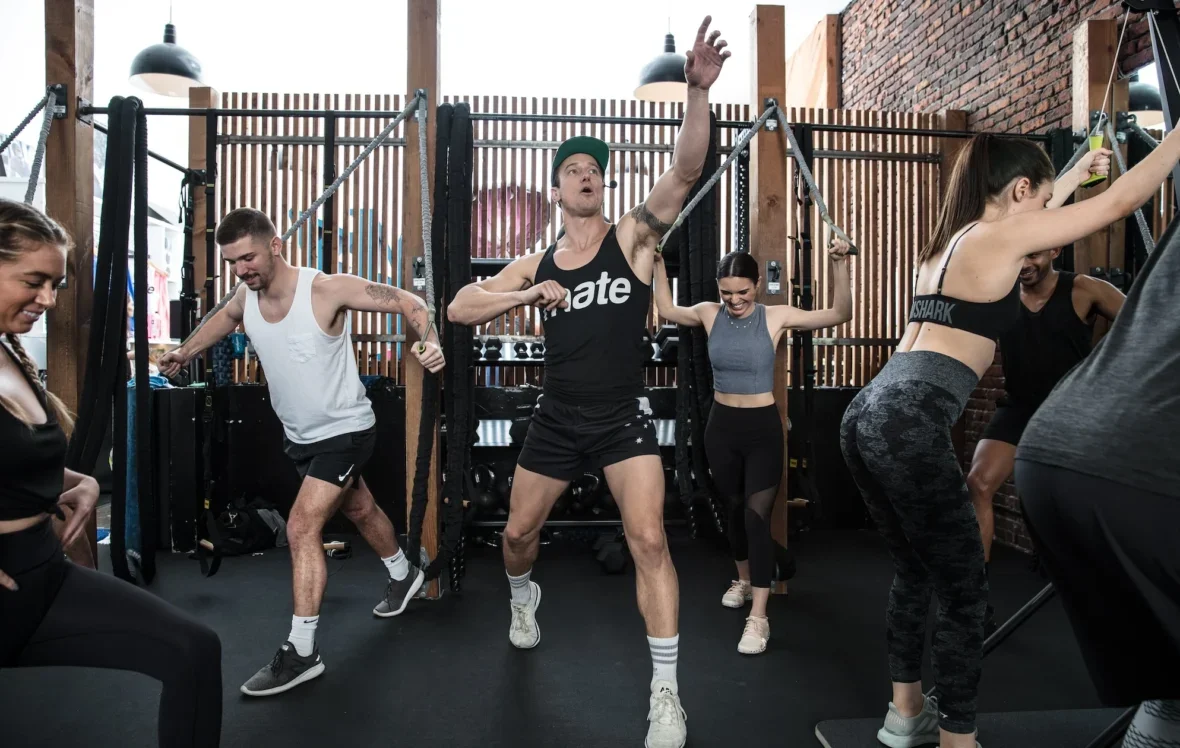
After a couple of years back in Australia, Milton started what would become Training Mate, initially as an outdoor boot camp split into three exercise stations — the same basic structure the brand still uses today. At the time, he called the business Milton Health Management, a name he now admits was uninspired. His girlfriend at the time, Carrie, was working as an executive at the advertising agency Saatchi & Saatchi. Milton recalls sitting with her one night trying to figure out how to brand and scale the business. When he explained that what made him different was that he trained with his clients personally — running alongside them, doing eight or ten sessions a day himself — she pointed out that he was, in effect, their training mate. He initially hated the name. She won the argument. Twelve or thirteen years later, Training Mate is the brand.
With some traction from the outdoor sessions, Milton decided to test the concept somewhere competitive: West Hollywood, which he calls the fitness capital of the world — the equivalent, he says, of trying to open a private bank on Manhattan, going up against big, well-funded, private-equity-backed studios. The West Hollywood location went viral within roughly a year, built around an Australian, communal, high-energy culture where everyone was welcome. From there the company expanded to Studio City and then Santa Monica. Notably, Milton says all of these early corporate locations were funded entirely out of cash flow — no outside capital. He’s frank that he came into the business with zero financial literacy: he says he’d never heard of a burn rate, a P&L, a balance sheet, or vendor management before having to learn all of it on the fly as the company grew and he had staff depending on him.
COVID hit the business hard, not just operationally but emotionally, according to Milton. The studios had to close temporarily, and the company pivoted to a takeout-style virtual offering to try to stay connected to members, but he says it wasn’t a substitute for what Training Mate actually delivered — human connection. He recalls receiving emails from clients who described feeling suicidal without the community the studios provided. That, he says, was the moment he realized Training Mate wasn’t a “want” for people — it was a need. Coming out of the pandemic, the company raised a small round from friends and family and began expanding more aggressively.
Milton now runs the company from Dallas, Texas, where he’s relocated and headquartered the business. According to Milton, Training Mate has around 13 units currently open, with more in the pipeline, including a location opening soon in Nevada, and expansion into Austin and Houston alongside the Dallas studios already running. He says what struck him was that the community impact was essentially identical in Dallas as it had been in Los Angeles, despite the cities being culturally very different. The company is now moving to a franchise model, and Milton says he’s assembled a first board of directors, including Nick Stone, founder of the coffee shop chain Blue Stone Lane, whom Milton describes as sharing the same philosophy around building community through hospitality.
Asked what he looks for in franchisees, Milton says he’s not interested in simply handing a studio to whoever can write a check. He wants people who have been part of a team and understand that the group matters as much as, or more than, the individual — people motivated to build healthier communities and willing to sacrifice individually for a collective win. He describes the in-studio experience in detail: a first-time visitor is nicknamed a “Joey,” after a baby kangaroo, and walked through a “Joey Journey” designed to make sure nobody feels intimidated, paired with a trainer who checks for injuries or needed modifications before the workout begins.
Looking back, Milton says awards and press — being named a top studio in multiple cities, or being called one of the top personal trainers in America — feel nice, but they’re not what drives him. What he points to instead are client milestones: people completing their 100th, 500th, or 2,000th class, couples who met at Training Mate getting married, and — increasingly — franchisees using the profits from their studios to buy homes, take vacations, or send their kids to private school.
His advice to aspiring entrepreneurs is blunt: where you’re from doesn’t determine where you’re going, and there’s no secret formula that makes some people more likely to succeed than others — just focus, passion, and a willingness to actually start. After that, he says, find like-minded people who will push you to keep evolving, both as a person and as a business operator.
Listen to the full conversation with Luke Milton on Apple Podcasts.