He Launched a Gummy Worm on Kickstarter. Now It’s in 6,000 Stores and Ferrara Sent a Cease-and-Desist
Michael Fisher studied management science and engineering at Stanford, where a friend once joked that his freshman-year dorm room was never without a bag of sour gummies. After graduating, he became a 2019 Venture for America fellow and was placed at Carewell, an online caregiver-supply company in Charlotte, North Carolina — a deliberate move out of the Palo Alto bubble that, he’s said, is where he first decided he wanted to build his own brand rather than work inside someone else’s.
The idea for Rotten came out of a fairly ordinary frustration. During COVID, Fisher was cutting sugar and soda out of his diet but still craved candy on road trips and during late-night TV — and every zero- or low-sugar gummy he tried on the market disappointed him. He started trying to make his own in his kitchen and quickly learned that gummies are, in his words, incredibly technical to formulate well. By mid-2021 he’d found a food-science R&D partner to help him get a real recipe together, built around allulose, a natural low-calorie sweetener derived from fruit, instead of the sugar alcohols or stevia most competitors leaned on.
Rotten’s first public test came via Kickstarter. The campaign, “Rotten: Sickeningly Delicious Gummy Worms,” launched September 8, 2021, and hit its $10,000 goal in four hours; by the time it closed a month later, 233 backers had pledged $38,131 — 383% of the original target. Fisher treated the backers as an informal product-testing group, and the feedback sent the recipe through another full round of reformulation before Rotten was ready for retail. The company formally launched online in October 2023, timed deliberately for Halloween.
The brand’s look has nothing to do with the clean, pastel aesthetic most “better-for-you” food brands reach for. Rotten built out a fictional mythology around a mad scientist named Dr. Rotten and a mascot called Franky Freak, leaning into late-1980s and 1990s gross-out culture — Garbage Pail Kids, Creepy Crawlers, old-school Nickelodeon — under the tagline “Feed Your Freak.” Fisher has cited Liquid Death, which he encountered after moving to Los Angeles, as a branding influence, and he’s been explicit about the order of priorities behind the product: taste comes first, packaging and personality second, and the better-for-you angle third — a deliberate rejection of leading with health claims the way most functional-candy brands do.
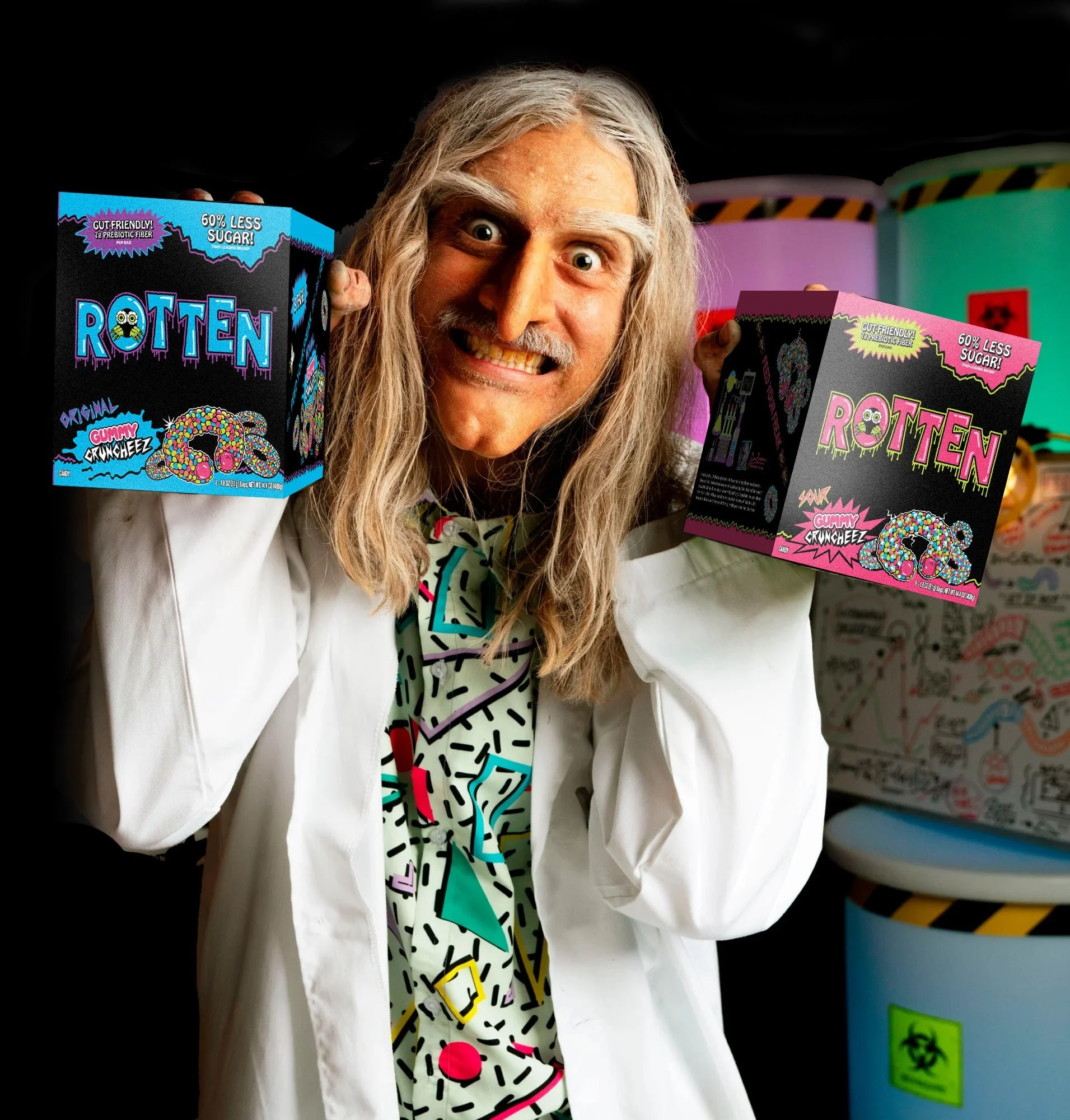
Growth since the 2023 relaunch has been steady rather than explosive-overnight: by January 2025, Rotten was in more than 1,000 stores, including Zumiez, Safeway, Sprouts, and Hy-Vee, and had sold more than 1 million units. At that point Fisher was reportedly still the company’s only full-time employee — everything else was contractors, freelancers, and the manufacturing partner. That started to change fast. By early 2026, according to one industry newsletter interview, Fisher had gone from running Rotten largely alone to leading a team of six within about three months, adding a head of sales and other functional hires as retail orders scaled past what one person could manage.
The company’s second product line became an unplanned test of how seriously a much larger competitor would take a small gummy brand. In 2024, Rotten developed Gummy Cruncheez, a soft-gummy-center, crunchy-shell candy positioned directly against Ferrara’s Nerds Gummy Clusters — a product Inc. has reported generates hundreds of millions of dollars a year for Ferrara. After Rotten showed a Cruncheez flyer at the industry’s Sweets & Snacks Expo in May 2024, Ferrara sent a cease-and-desist letter before the product had even launched. Rotten launched Gummy Cruncheez anyway, on January 28, 2025, and the product line went on to place in Sweets & Snacks Expo’s own Most Innovative New Product Awards the following year — Sour Tiniez won the Non-Chocolate category outright in May 2026, against nearly 500 entries, the largest field in the program’s history.
Not every setback got resolved so cleanly. In the second half of 2025, a manufacturing run went wrong and left Rotten with more than $200,000 worth of gummy worms that were out of spec — too sticky to sell through normal channels. Rather than write the batch off, the team turned it into a flash sale on TikTok Shop, branded as “Mutated Worms,” and reportedly moved through the defective inventory at a strong clip. It’s a small story, but it’s the kind of scrappy inventory problem-solving that rarely makes it into a company’s official history — more often it just gets buried under the bigger retail-expansion headlines.
On the product side, every Rotten SKU is sweetened primarily with allulose, a naturally occurring low-calorie sugar found in figs, raisins, and maple syrup, combined with real fruit juice and powder rather than artificial dyes. The sugar-reduction claims have shifted somewhat as the recipe went through retail reformulation — 70% less sugar at the original 2021 Kickstarter launch, closer to 60% less sugar in the current retail lineup — which is a reasonably normal outcome of moving from a crowdfunded prototype to a shelf-stable, retail-scale product. The current lineup spans Wormz (the original gummy worms), Cruncheez, and, as of 2026, two newer lines: Tiniez, a bite-sized format with 11 grams of protein per serving and more than 40% less sugar than conventional candy, and Chewerz, a fruit-chew format with Rotten’s signature crunchy coating, 11 grams of protein, and 5 grams of fiber per serving. By mid-2026, the company said its products were in more than 6,000 retail locations, including Kroger, Costco, Safeway, Giant, Meijer, and Dick’s Sporting Goods, with a national Sprouts rollout planned for that September — a genuine jump from the 1,000-store footprint of early 2025.
Rotten is riding a real trend rather than inventing one. The better-for-you segment of the candy aisle has been growing far faster than traditional candy — industry sources have cited double-digit annual growth for low-sugar gummies against roughly flat growth for conventional candy — and Rotten now sits alongside better-known names like SmartSweets and Zolli Candy as part of that shift, while positioning its horror-comic branding as the opposite of the clean, minimalist look most of those competitors use. Taking on Ferrara, a company many times its size, over a single product line was a real risk for a company that size; that Rotten kept selling Cruncheez through the legal pressure and later won an innovation award for a related product suggests the bet on branding and taste over a straightforward health pitch is working, at least so far.
In this episode, Michael talks through building a food brand from a kitchen experiment into national retail distribution, what it actually took to reformulate a product after a Kickstarter, and how a small company decides whether to back down when a much bigger one sends a legal letter.
Listen to the full conversation with Michael Fisher on Apple Podcasts
Make sure to check out Rotten at: https://eatrotten.com/
Check out my new book on Amazon: https://amzn.to/4kRKGTX
Sign up for Starting Small University to join our interviews LIVE and ask questions: https://startingsmallmedia.org/startingsmalluniversity
Visit Starting Small Media: https://startingsmallmedia.org/
Subscribe to exclusive Starting Small emails: https://startingsmallmedia.org/newsletter-signup
Follow Starting Small:
Instagram: https://www.instagram.com/startingsmallpod/
Facebook: https://www.facebook.com/Startingsmallpod/
LinkedIn: http://linkedin.com/in/cameronnagle