He Left a C-Suite Job at Capgemini to Build a Hydroponic Farm That Raised $55 Million
FX Rouxel studied computer science at École Polytechnique before earning an elite French engineering credential, Ingénieur du Corps des Mines, at École des Mines de Paris. He started his career at the French Environment Protection Agency and spent years in the energy industry working on carbon-free power technology, then moved into consulting, eventually becoming CEO of Infrastructure Services at Capgemini, the global technology and consulting firm. He was training for an Ironman triathlon when he noticed his energy plateauing despite what he thought was a healthy diet — and traced the problem back to how much nutritional value fresh produce loses during the days or weeks it spends in transit between a farm and a grocery shelf.
That realization, paired with his background in clean energy, automation, and AI, became the starting point for Gardyn, which he founded in 2018 in Bethesda, Maryland. The core technology is a trademarked closed-loop watering system Gardyn calls Hybriponics, which recirculates water through a hydroponic growing column and uses roughly 95% less water than conventional field agriculture to grow the same amount of produce. Rouxel built the company around a fairly direct pitch: give people a way to grow real vegetables and herbs at home, without soil, a yard, or much water, using an AI assistant to handle the parts of gardening most people get wrong.
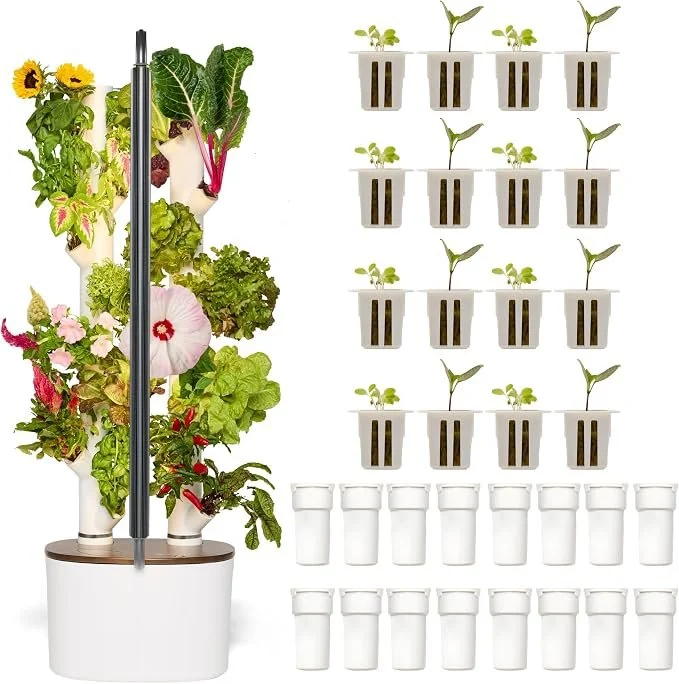
The system itself is built around what Gardyn calls yCubes — pre-seeded plant pods that snap into a vertical growing column and get monitored by an onboard AI assistant Gardyn calls Kelby. Kelby uses a camera plus temperature and humidity sensors to track each plant’s growth, automate watering and lighting on the recirculating Hybriponics system, and send push notifications through a companion app when something needs attention or is ready to harvest. Gardyn markets the yield from a single unit as comparable to a roughly 1,300-square-foot outdoor vegetable garden, without soil, weeding, or a backyard. In October 2025, the company launched Studio 2, a compact version built for small spaces — a 1.4-square-foot footprint holding 16 plants, priced at $549 (or financed at about $23 a month), with sealed silicone growing modules the company says don’t need scrubbing, an upgraded wide-angle camera, and lighting modes that mimic natural sunrise and sunset cycles. An optional $19-a-month membership adds plant refills, exclusive seed varieties, and ongoing access to Kelby’s monitoring and support.
Gardyn has raised $55 million across a seed round and two priced rounds — a $15 million Series A in 2021 and a $35 million Series B in 2022, both led by JAB Ventures, the venture arm of the German conglomerate behind brands like Keurig Dr Pepper and Krispy Kreme. By the company’s own count, more than 100,000 Gardyn systems have been sold, and its users have collectively grown over 3.5 million pounds of produce, saved more than 60 million gallons of water, and kept nearly 1.9 million pounds of food waste out of landfills. Alongside direct sales through mygardyn.com, the company sells through Amazon and Home Depot. Since 2021, it has also run a philanthropic arm called the G3 Initiative, donating systems to underserved communities and partnering with schools and nonprofits on food-desert and food-education programs — a project that traces back to the February 2021 Texas winter-storm power crisis. In March 2026, Gardyn became eligible for HSA and FSA reimbursement through a partnership with Truemed, which the company says makes it the first indoor-gardening brand to reach that status, cutting the effective cost by roughly 30% for eligible customers who complete a short health survey.
The category Gardyn competes in has gotten more crowded and more volatile in recent years. Rise Gardens, a Chicago-based competitor founded in 2017, offers a modular tiered system that scales up to 108 plants; AeroGarden, the older and better-known name in the space, is owned by Scotts Miracle-Gro and has had a rockier stretch — Scotts began winding the brand down in late 2024, reversed course in early 2025, but never brought back several discontinued models. Lettuce Grow’s Farmstand line rounds out the main competitive set. Gardyn’s own comparison pages position it against both AeroGarden and Rise Gardens directly, leaning on the AI-and-app layer, water efficiency, and yield claims as its main points of difference. The broader category sits at the intersection of a few real trends — smart-home appliances, food-security and food-desert concerns, and a general resurgence of interest in growing at least some of your own food — rather than any single, easily quantified market boom.
In this episode, FX walks through what it took to go from an Ironman-training engineer with no agriculture background to running a funded hardware company, why he bet on AI and automation to make gardening foolproof rather than simplifying the plants themselves, and what he’s learned about building a subscription hardware business that has to work in someone’s kitchen, not just in a lab.
Listen to the full conversation with FX Rouxel on Apple Podcasts
Make sure to check out Gardyn at: https://mygardyn.com/
Check out my new book on Amazon: https://amzn.to/4kRKGTX
Sign up for Starting Small University to join our interviews LIVE and ask questions: https://startingsmallmedia.org/startingsmalluniversity
Visit Starting Small Media: https://startingsmallmedia.org/
Subscribe to exclusive Starting Small emails: https://startingsmallmedia.org/newsletter-signup
Follow Starting Small:
Instagram: https://www.instagram.com/startingsmallpod/
Facebook: https://www.facebook.com/Startingsmallpod/
LinkedIn: http://linkedin.com/in/cameronnagle