Elix: How Lulu Ge Brought Traditional Chinese Medicine to Modern Women’s Health
Lulu Ge spent the first phase of her career about as far from herbal medicine as a career can get. She studied political science and art history at UC San Diego, earned a master’s in social-organizational psychology from Columbia, and later added an MBA from Wharton. Along the way she worked as a management consultant advising Fortune 100 companies on strategy and transformation, developed leadership programs for Chinese government and business leaders, and eventually led change-and-transformation work at Hudson’s Bay Company and Saks Fifth Avenue, overseeing a portfolio of strategic initiatives she has said was valued at more than $350 million across 45,000-plus employees.
Ge grew up in California after being born in China, and Traditional Chinese Medicine was part of her life from childhood — her grandfather ran a hospital in China, and bone broths and herbal remedies were a normal part of how her family dealt with everyday ailments. The idea for Elix took shape after Ge went off birth control roughly three years before the company launched and developed a cascade of severe symptoms: cramps, acne, hair loss, migraines, and fatigue. Conventional doctors repeatedly offered her the same answer — go back on birth control — without addressing the underlying hormonal issue. Her grandfather connected her with Dr. Xia Hongsheng, a Traditional Chinese Medicine practitioner in Shenzhen, whose personalized herbal formula meaningfully improved her symptoms within months. That experience, combined with her own frustration that no modern, data-driven version of this kind of personalized herbal medicine existed in the U.S. market, became the direct inspiration for Elix, which she developed while at Wharton.
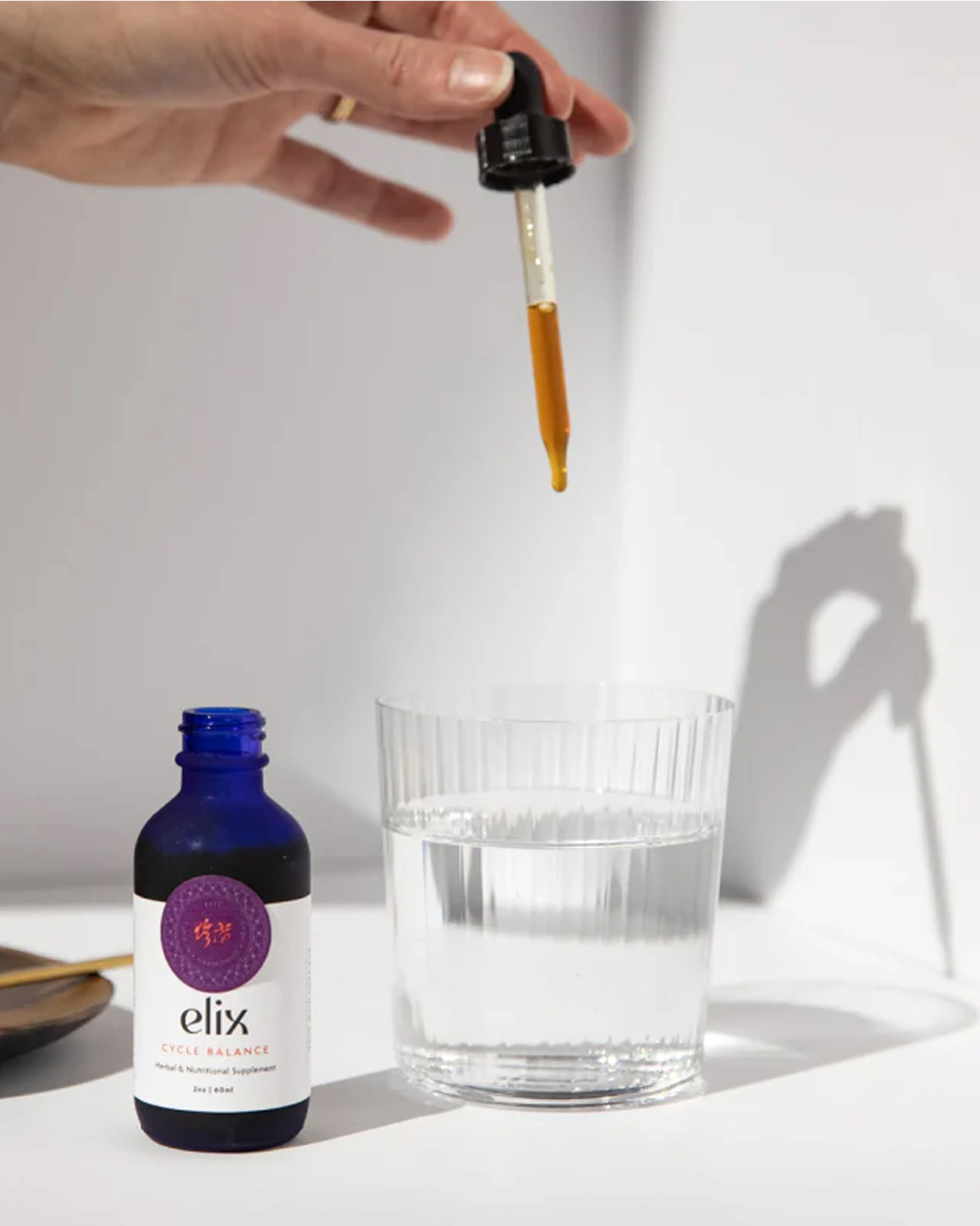
Elix was founded around 2019 and publicly launched its product in early 2020, after nearly a year of piloting personalized herbal formulas with more than 300 women through a beta website. The company sells liquid herbal extracts and tonics built around Traditional Chinese Medicine principles, targeting menstrual, hormonal, stress, sleep, digestion, and immune health, with an intake assessment that personalizes each formula to the individual customer rather than offering one generic product for everyone. The flagship line, Cycle Balance, addresses menstrual and hormonal symptoms directly, alongside products like Daily Harmony, Ginger Aide, and an Immunity Support duo. According to a case study Shopify published about the company, Elix has completed close to a million health assessments since launch and reports a 90 percent repeat-purchase rate among customers — both figures self-reported by the company rather than independently audited.
Elix has raised roughly $2.7 million from a collection of investors, according to press coverage, rather than growing purely through revenue and bootstrapping the way some other founders in this series have. Reported backers include Daft Capital, Recharge Capital, The Pay It Forward Company, and Tribe Capital, though that investor list comes from third-party business databases rather than a direct company announcement and should be treated as approximate. Third-party estimators put Elix’s annual revenue in the low single-digit millions with a headcount in the twenties, though these figures are not company-confirmed and third-party revenue estimators are known to be imprecise. What is more directly sourced is that Elix reached its first $1 million in sales at some point after launch, per the company’s own account shared in that Shopify case study.
Elix sits inside several overlapping, genuinely large markets. Industry researchers estimate the global women’s health supplements market at roughly $62 billion in 2025, growing toward $130 billion by 2035, while the more specific personalized women’s nutrition category is estimated at around $3.5 billion in 2025 and projected to roughly double by 2033. Both figures vary meaningfully depending on which research firm produced them, so they should be read as directional rather than precise. Within that broader landscape, Elix’s specific niche — technology-enabled, personalized Traditional Chinese Medicine — has relatively few direct competitors positioning themselves the same way, though it competes indirectly with the much larger universe of women’s health supplement and hormone-support brands. Part of Elix’s pitch leans on a widely cited but hard-to-independently-verify statistic that a majority of women report feeling dismissed or unheard by medical providers at some point, which the company uses to frame its personalized herbal approach as an alternative to a healthcare system it argues has underserved women’s hormonal health specifically.
On the podcast, Ge talked about the challenge of translating a centuries-old medical tradition into a modern, trustworthy, data-backed consumer brand — sourcing organic herbs at scale, working with clinical research to back up efficacy claims, and building customer trust in a wellness category that is often associated with unverified or pseudoscientific claims. She also discussed launching the company just as the COVID-19 pandemic hit, which forced Elix to build its early customer base through virtual community and word-of-mouth rather than in-person events or traditional retail relationships, and how that constraint ended up shaping the brand’s direct-to-consumer, content-driven approach to customer acquisition from the very beginning.
Ge’s path from management consulting to Traditional Chinese Medicine is a useful reminder that founders often build their most durable businesses at the intersection of a deeply personal problem and a skill set they didn’t originally think was relevant to solving it. Her years spent analyzing operations and customer data inside large retail and consulting organizations gave her exactly the tools needed to systematize something as old and as personal as her grandfather’s herbal formulas into a scalable, data-informed consumer product. Whether Elix can keep growing at the pace its founder-reported numbers suggest, in a wellness category crowded with both credible science and unverifiable marketing claims, will depend on whether the company can keep proving out the clinical backing it says differentiates it from the rest of the supplement aisle.