Boone Whiteside grew up near Highland Street in North Boulder, Colorado — the source of the company’s name — and met Ben Medalie during Boone’s junior year at the University of Colorado Boulder, where both studied strategic communication. As students, Boone grew frustrated that every hair product he tried, at every price point, came wrapped in single-use plastic with long, hard-to-pronounce ingredient lists. He started researching natural alternatives and ordering bulk shea butter, beeswax, clays, and oils to the Denver apartment he shared with Ben, mixing early batches in a pot on their stove and, later, his mom’s KitchenAid stand mixer. That experimentation ran for roughly two to three years before they had a formula worth selling.
Highland launched during the COVID lockdowns of 2020, with Boone formalizing his co-founder role in 2021 while both he and Ben kept their day jobs — Boone in a customer-success role at an e-commerce startup, Ben in an analyst role — running the company as a side hustle for roughly two years. Early sales went to friends, family, and local Denver-area barbershops and salons through a bare-bones Shopify store. By their own account to Entrepreneur, monthly revenue crept from $1,000 to $3,000 in the earliest stretch before climbing to consistent $10,000-to-$20,000 months by mid-2023 — the point at which they both quit their jobs to run Highland full-time.
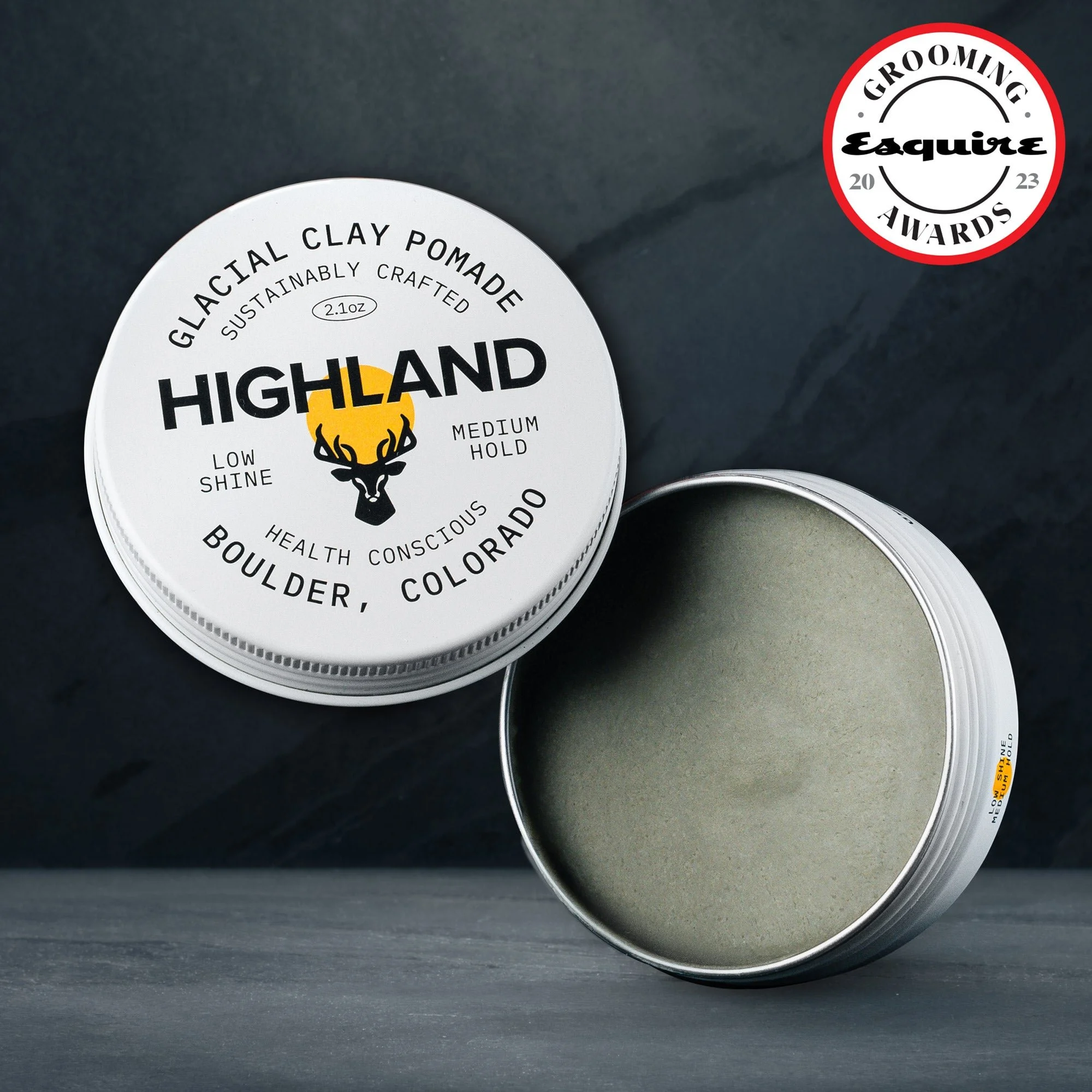
The flagship product, Glacial Clay Pomade, is a nine-ingredient formula built around Canadian glacial clay, shea butter, beeswax, jojoba oil, and kaolin clay, with no synthetic preservatives or fillers — a medium-hold, low-shine styling clay that retails for around $27. It won Esquire’s Best Hair Clay grooming award in 2023, and the brand’s second product, Glacial Cream, won a GQ Grooming Award the same year. Manufacturing has since moved from that first apartment stovetop to a Los Angeles production partner, though the founders have said natural formulations are genuinely harder to scale than synthetic ones — batch consistency is less forgiving and shelf life is shorter, which pushed R&D on each new product past six months. In 2024, Highland added The Wash, a $38 botanical scalp cleanser built around rosemary, caffeine, and hyaluronic acid and aimed at hair-thinning and scalp-health concerns, developed over roughly a year with an outside organic chemist; a conditioner has since rounded out the lineup as well.
Distribution has stayed close to the brand’s roots: Highland sells primarily direct-to-consumer through its own site and Amazon, alongside more than 150 independent barbershops and salons nationally — there’s no big-box or national beauty-retail partner yet, which keeps the brand’s margins and story more founder-controlled than most competitors at this stage. According to reporting in Inc. and Entrepreneur, Highland became profitable in 2024 and reported $12.5 million in revenue in 2025, with the founders telling Inc. they expect to top $20 million in 2026; Entrepreneur also reported the company hit occasional $1 million sales months along the way. The company has stayed largely self-funded, raising a friends-and-family round rather than institutional venture capital — Entrepreneur reported a larger investor deal fell through at one point, creating a real cash-flow scare, though the founders have said in hindsight it left them owning more of the business. Highland has also joined 1% for the Planet, donating a share of sales to environmental causes, and ships in 100% recyclable aluminum packaging — positioning itself less around classic barbershop nostalgia and more around the kind of sustainability credibility usually associated with outdoor brands, in a men’s grooming market that global estimates put anywhere from roughly $70 billion to $95 billion and growing at a mid-single-digit pace, with the hair-styling and scalp-health segments specifically growing faster than the category overall.
In this episode, Boone and Ben share how they built Highland from DIY experiments into a business that redefines performance, health, and sustainability in haircare.
Listen to the full conversation with Highland on Apple Podcasts
Cameron Nagle is the founder and host of Starting Small, creator of the Starting Small Summit, and author of Starting Small: The Raw Truth About Entrepreneurship and the American Dream. About Cameron | Listen on Apple Podcasts