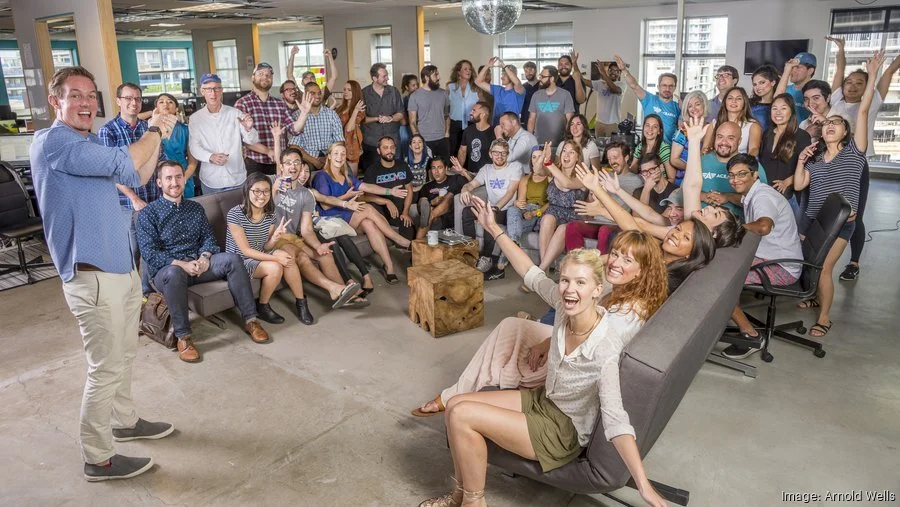
Aceable: How Blake Garrett Built an Online Licensing Education Empire
Blake Garrett spent six years at Ernst & Young as a systems integration consultant before he ever thought about building his own company. He studied management with a concentration in accounting at Boston College, and while at EY he founded a side program called the EY Austin College MAP, designed to help high school juniors and seniors navigate the path to college. That volunteer project turned out to be the spark: it gave Garrett a taste for education work, and by the time he left EY, he had decided to build a company around a belief that licensing education — the mandatory, often tedious coursework required to get a driver’s license, a real estate license, or other professional credentials — was fundamentally broken.
Garrett founded Aceable in 2013, working out of Capital Factory, the Austin startup incubator that has launched a long list of Texas tech companies. The original idea was to gamify textbooks and training manuals; an early advisor pushed Garrett toward a narrower, more practical wedge instead — mandatory, state-regulated education that people had to complete no matter what, delivered through a mobile app instead of a classroom or a clunky desktop course. The first product, a Texas parent-taught driver’s education course, launched in 2014. From that single course, Aceable expanded methodically into new state-mandated categories: driver’s education nationally, real estate pre-licensing and exam prep under the AceableAgent and PrepAgent brands, mortgage education, e-bike and scooter safety courses, and, as of March 2025, property and casualty and life and health insurance licensing under a new Aceable Insurance brand.
Growth for Aceable has come through both organic expansion and acquisition. The company bought I Drive Safely and Driversed.com to deepen its driver’s education footprint, acquired real estate exam-prep company PrepAgent in 2021, and in August 2024 acquired the Real Estate Institute, an Illinois-based professional licensing education provider, from Greybull Stewardship. On the funding side, Aceable raised a $47 million Series B in December 2018 led by Sageview Capital, followed by a $50 million growth investment from HGGC in December 2020 — bringing total disclosed funding to somewhere in the range of $100 million to $106 million across multiple rounds, depending on which aggregator’s figures are used, with investors including Silverton Partners, Floodgate, Next Coast Venture Partners, and Wildcat Venture Partners alongside HGGC and Sageview.
Aceable’s own marketing materials say the company has licensed more than 20 million students across its various programs, with roughly 1.5 million students per year moving through its courses in more than 40 accredited states. Third-party estimates, which are not audited and should be treated as approximate, put Aceable’s annual recurring revenue at roughly $25.8 million in 2024, up from about $14.1 million the year before, with a headcount somewhere between 218 and 240 employees depending on the data source. In its own March 2025 press release announcing the insurance-licensing expansion, the company said its real estate education revenue had grown at a 38 percent compound annual growth rate over five years and that EBITDA had tripled over the same period — figures that, like most growth statistics young companies publish, come from the company itself rather than an independent audit.
Aceable operates at the intersection of two large markets. The U.S. driving-school industry alone is estimated at roughly $2 billion, while the global driver education and training services market is projected to roughly double from around $810 million to $1.79 billion by 2034. Layer in the much broader test-preparation and professional-licensing education category — valued in the tens of billions of dollars globally — and Aceable’s addressable market is substantial, even though it operates in a narrower niche than SAT-prep or general online learning platforms. Within real estate education specifically, Aceable’s AceableAgent brand competes against larger, more established players like Colibri Real Estate, Kaplan Real Estate Education, and The CE Shop, most of which offer live instruction across more states; AceableAgent has differentiated by staying asynchronous and mobile-first, with a narrower state footprint but a heavily marketed “Ace or Don’t Pay” guarantee for students who don’t pass on their first attempt.
On the podcast, Garrett talked about what it takes to build a business around products people are legally required to buy rather than products they necessarily want — a structurally different challenge than most consumer startups face, since demand is guaranteed by state regulation but customer satisfaction and word-of-mouth still determine whether a student chooses Aceable over a competitor the next time they need a license renewed. He also discussed the operational complexity of running an education company that has to stay compliant with dozens of different state regulatory bodies simultaneously, each with its own curriculum requirements, approval processes, and renewal cycles — a form of regulatory complexity that acts as both a barrier to entry for new competitors and a constant operational burden for Aceable itself.
Garrett’s path is a useful case study in how a founder can build a durable, multi-hundred-million-dollar company without a flashy consumer hook, by identifying an unglamorous but genuinely large category — mandatory licensing education — and systematically expanding into adjacent verticals that share the same regulatory logic and the same mobile-first delivery model. Twelve years and multiple acquisitions after that first Texas driver’s ed course, Aceable now spans driving, real estate, mortgage, and insurance licensing under one roof, a portfolio built less on a single breakthrough idea than on the patient, category-by-category execution of the same basic insight: wherever a government requires people to get licensed, there is room for a better way to teach them.