Curious Elixirs: How JW Wiseman Built a $50 Million Non-Alcoholic Cocktail Brand
JW Wiseman’s career before Curious Elixirs was a tour through hospitality and media rather than a straight line toward beverages. He worked in marketing at Thrillist, co-owned a whiskey bar in Brooklyn with his brother, co-founded the Brooklyn nightclub OUTPUT, and later ran a growth-marketing agency called Good Business that worked with clean-food brands like Daily Harvest and Chomps. Around 2012, while developing a hotel project in Rockaway Beach, he had a night out that involved roughly 20 drinks with no hangover the next day — an experience he has described as genuinely scary rather than impressive. He decided to cut back drastically, by his own account roughly 95 percent, and immediately ran into a problem: there was nothing sophisticated to drink instead.
Wiseman started tinkering with recipes in his own kitchen, consulting bartenders, food scientists, and herbalists to build a non-alcoholic drink that felt like a real cocktail rather than a glorified soda. He tested an early version at a party at his Rockaway Beach hotel, and by his account it drained faster than any alcoholic drink on offer that night — a strong enough signal that he decided to turn the experiment into a business. Curious Elixirs launched around 2015, funded initially by a Kickstarter campaign that raised roughly $37,000 and brought in the company’s first several hundred customers. Wiseman has said the company has never raised outside equity investment, instead relying on revenue and non-equity financing tools like Shopify Capital to fund production runs — an unusual approach for a beverage brand operating at real scale.
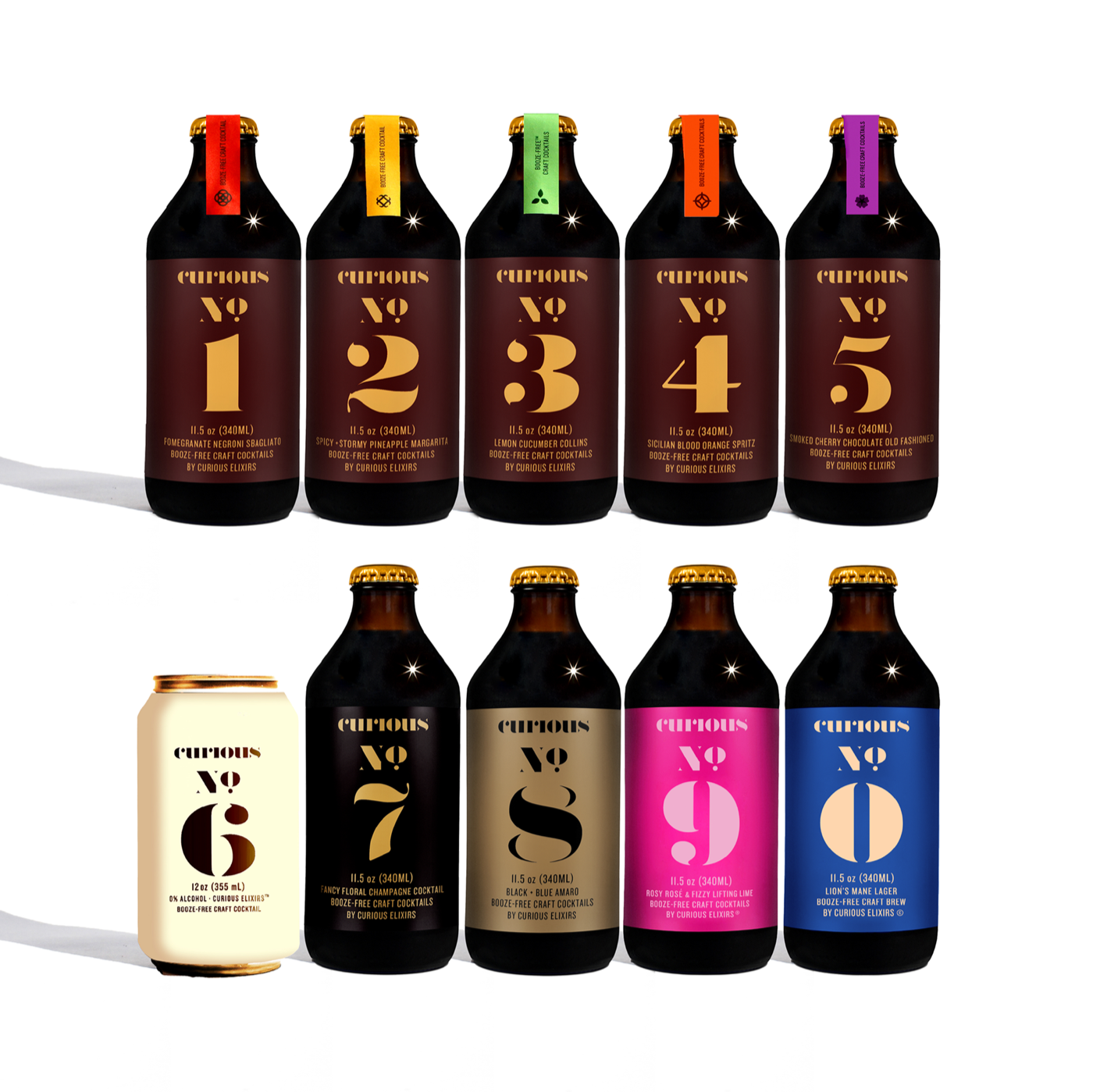
The product itself is built to satisfy actual cocktail nerds rather than people looking for a juice substitute. Curious Elixirs sells a lineup of numbered, ready-to-drink elixirs — each one a riff on a classic cocktail like a Negroni Sbagliato, a margarita, a Collins, a spritz, an Old Fashioned, and a piña colada — built around a different adaptogenic herb or botanical such as rhodiola, ashwagandha, ginseng, or lion’s mane mushroom. The company has since expanded into Curious Zero, a non-alcoholic craft lager, and in February 2026 launched Curious Red, a non-alcoholic Syrah-style wine, timed to the brand’s 11th anniversary. The drinks contain no added or refined sugar, use organic ingredients the company says are sourced from six continents, and are gluten-free and largely caffeine-free. A four-pack typically runs somewhere in the $44 to $59 range, positioning Curious Elixirs well above mass-market mocktail mixers and closer to a premium spirits price point.
Growth has reportedly been substantial, though the figures come from Wiseman’s own interviews rather than any audited or independently verified source. He has said the company generated about $176,000 in revenue in its first year, roughly $2.2 million cumulatively over its first five years, and more than $50 million cumulatively over the five years after that — a trajectory he describes as a brand growth multiple of roughly 20 times, with current annual revenue comfortably in the eight figures. Wiseman has also projected the company could reach $176 million in annual revenue by 2030, a founder projection rather than a guarantee. Curious Elixirs says its products are now available in more than 2,000 retail locations, and the brand has been named the New York Times’ pick for best non-alcoholic drink multiple years running, alongside a spot on the 2025 Inc. 5000 list of fastest-growing private companies.
Curious Elixirs is riding a broader wave in the beverage industry sometimes called the sober-curious movement. Market research estimates for the space vary considerably depending on the firm and exact category definition, but the global mocktails market has been put at roughly $12.6 billion in 2025 with projections reaching close to $29 billion by 2034, while the broader premium non-alcoholic drinks category has been estimated at around $28.6 billion in 2025 growing toward $62 billion by 2034. One 2025 industry survey found nearly half of Americans planned to drink less that year, up from 44 percent two years earlier — evidence of a real shift in consumer behavior rather than a passing trend. Curious Elixirs competes in that space against other non-alcoholic spirit and cocktail brands, though Wiseman has consistently framed the company as one of the category’s earliest entrants, having launched years before “sober curious” became a mainstream marketing term.
On the podcast, Wiseman talked about the discipline required to keep bootstrapping a beverage company for more than a decade without outside equity — a choice that trades faster potential growth for full control over the brand and product, at the cost of the marketing budgets and distribution muscle that venture-backed competitors can deploy. He also discussed the challenge of getting retailers, restaurants, and bars to take a non-alcoholic product seriously as a craft cocktail rather than a novelty, a perception problem the category has only started to overcome in the last several years as high-profile restaurants like Daniel and The French Laundry began carrying the brand alongside their alcoholic cocktail programs.
Wiseman’s story is a reminder that not every large consumer brand starts with venture backing or a clear market opening — Curious Elixirs began as one man’s kitchen-table solution to his own drinking problem, built without institutional investors and expanded slowly over more than a decade before the broader culture caught up to what he was already selling. Whether or not every figure in that growth story holds up to outside scrutiny, the underlying arc — a bootstrapped, founder-funded beverage brand reportedly doing eight figures in annual revenue and sitting in thousands of retail locations more than ten years after a $37,000 Kickstarter campaign — is a genuinely unusual outcome in a beverage industry where most successful brands eventually take on institutional capital to fund the retail and marketing muscle needed to compete at scale.