
When Michael Jacobson picked up the phone in 2018, his uncle wasn’t asking for help growing French Florist — he wanted help selling it. The Los Angeles flower shop, founded in 1978, had been in the family for four decades, but after roughly 38 years running it six days a week, 60 hours a week, Michael’s uncle wasn’t making meaningful money on it anymore. Michael, fresh off a stint in strategy consulting, figured he’d help broker a clean exit. Instead, he found a business that had lost the operational fundamentals a lot of small, family-run florists never build in the first place — and decided to fix it rather than flip it.
Michael’s instincts for this go back further than the flower shop. As a kid, after his school banned vending machines, he started selling soda out of his locker — a story he still tells when he talks about where his business instincts came from. His father let him skip school to read instead, something Michael has credited with shaping how he thinks about problems, and he’s pointed to Steve Jobs as an early influence on how he approaches building a company. By the time his uncle called about selling the shop, Michael had already worked as a real estate broker during college and spent time in strategy consulting — experience that showed up immediately in how he looked at French Florist’s numbers instead of just its flowers.
The turnaround started small and unglamorous. Michael cut the shop’s phone bill from roughly $1,300 a month to about $100 by renegotiating the setup, and he built a simple iPad-based ordering app that eliminated more than $10,000 a year in printer and paper costs tied to handwritten order tickets. None of it was flashy. It was the kind of blocking-and-tackling most small, family-run florists never get around to because they’re too busy arranging flowers to fix the back office.
That instinct — fix the plumbing before you touch the storefront — became the throughline of Michael’s rebuild. Rather than rushing to open new locations, he spent roughly four years building out French Florist’s operational backbone: proprietary order-management software, predictive-analytics tools for demand forecasting, and inventory systems built specifically for a perishable product with wild, holiday-driven demand swings. He’s said he invested more than $1 million into that software before ever going after a franchise partner, a sequencing choice that ran opposite to how most small retail brands try to scale.
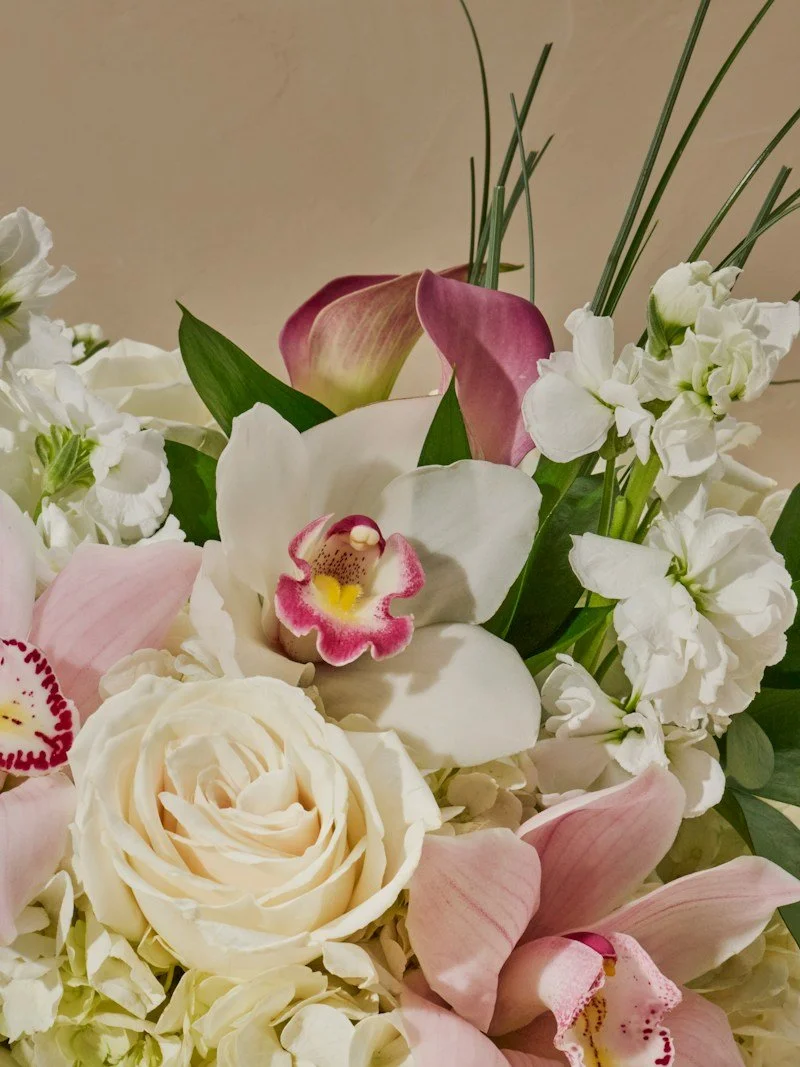
The bet on technology shows up in how the company takes orders today: roughly 95% of French Florist’s business now comes through its own e-commerce platform rather than phone calls or walk-ins, with each online order automatically routed to the nearest company-owned boutique for local design and same-day, hand-delivered fulfillment — never shipped in a box. That distinction matters in an industry where a meaningful share of a customer’s experience comes down to whether the arrangement that shows up looks like the photo they ordered from, and it’s a direct point of contrast with ship-in-a-box competitors.
Some of that trust shows up in small design choices that are easy to overlook. Every French Florist arrangement is designed and assembled the same day it’s delivered rather than pre-made and warehoused, which the company argues is the real differentiator against national wire services that route an order through several intermediaries before a local florist ever touches it. It’s part of why Michael was willing to spend four years and seven figures on backend software most customers will never see directly — the entire pitch depends on the online order matching what actually shows up on a customer’s doorstep, every time, at every location.
Under Michael, French Florist grew from that roughly $600,000-a-year shop his uncle was ready to sell into a business reporting north of $9 million in annual revenue, with its three flagship, company-owned locations in Los Angeles, Westlake Village, and Costa Mesa generating, according to floral-industry trade coverage, roughly three times the revenue of a traditional independent florist. The company has also built a loyal customer base along the way — well over 5,000 five-star reviews on its consumer site, a number that later trade coverage put closer to 9,000 as the brand expanded.
In 2024, Michael took the model public in a different sense: French Florist launched its franchise program, opening the operational playbook he’d spent years building to outside owners. The company raised $3 million that September to fund the expansion, with a goal of adding 15 franchise locations by the end of 2025. It’s a pace the business says it can sustain — Michael has put the realistic ceiling at around 20 new units a year — and by early 2026, French Florist had awarded 45 territories, with the company’s Director of Franchise Growth, Glenn Anderson, calling it one of the most significant growth stretches in the brand’s history and pointing to a robust pipeline heading into the new year. The next wave of expansion is targeting dense, high-demand metro markets including Texas, the New York City area, and Florida.
The timing lines up with real movement in the floral industry. The U.S. floral gifting market is projected to grow from roughly $12.5 billion in 2025 to more than $17 billion by 2031, but the incumbents aren’t necessarily capturing that growth cleanly — 1-800-Flowers.com, the closest thing the category has to a household name, reported a 9.3% decline in e-commerce revenue in fiscal 2025, citing a tough macro environment and an overly promotional market, even as it moved to acquire premium direct-to-consumer players like Farmgirl Flowers to shore up its high-end offering. Competitors including FTD have leaned into AI-driven bouquet recommendation tools to chase the same tech-forward customer French Florist has been building toward since well before it started franchising.
Michael has built some of that ethos into the brand itself. French Florist’s tagline is “You are loved,” a phrase the company etches directly onto its vases, and its designers, who the company says average more than a decade of floral experience, go through an in-house training program before working a shop floor. It’s a small detail, but it’s consistent with how Michael talks about the turnaround: less about chasing a flashy exit, and more about proving a decades-old flower shop could be run like a real, scalable business without losing what made people trust it in the first place. He turned a shop that couldn’t support the family that owned it into a national franchise opportunity in under a decade — doing it by fixing print bills and phone contracts long before he ever spent a dollar on a rebrand.
In this episode, Michael walks through the behind-the-scenes rebuild: from fixing operations most florists never touch, to proving that even a flower shop can be built like a high-growth business.
Listen to the full conversation with Michael Jacobson on Apple Podcasts
Cameron Nagle is the founder and host of Starting Small, creator of the Starting Small Summit, and author of Starting Small: The Raw Truth About Entrepreneurship and the American Dream. About Cameron | Listen on Apple Podcasts