
Jacob Zuppke is the President and CEO of Whisker, the pet tech company behind Litter-Robot, but he isn’t the company’s founder. That was Brad Baxter, a former Ford Motor Company employee who inherited two cats around 1999, hated scooping their litter, and set out to build something better. Baxter found an inventor who had already patented a sifting mechanism for self-cleaning litter boxes, licensed the design, and funded the first prototype with money from his parents. He sold his first unit at a trade show in April 2000 and launched the company — originally called Automated Pet Care Products — selling direct to consumers online. It became profitable by 2005, years before Zuppke ever walked in the door.
Zuppke joined in 2015 as a marketing consultant, brought on just ahead of the Litter-Robot 3 launch when the company’s entire marketing function was essentially two people. He moved into VP of Marketing and Business Development in 2017, then climbed through Executive Vice President and Chief Operating Officer before becoming President, and finally President and CEO in January 2022, when Baxter stepped back to become Chairman and Chief Inventor. Over that stretch the team grew from 25 employees to more than 650, including over 100 engineers, and the company rebranded from Automated Pet Care Products to Whisker as it expanded beyond a single product into a broader connected pet-care platform.
Over the past four years, Whisker has surpassed $1 billion in cumulative revenue, a figure Zuppke has cited directly on the podcast. The company has never raised a dollar of venture capital — no Series A, no growth round chasing a valuation target, none of the usual startup financing playbook. It ran on founder capital and reinvested profit for its first two decades. The one real exception is a 2019 recapitalization: private equity firm Pondera Holdings led a $31 million investment in the company, alongside Aldine Capital Partners and Promus Equity Partners. That deal is typically described as a liquidity event that let Baxter and early stakeholders cash out some of their equity, not as growth capital the company needed to survive or scale — a meaningful distinction from a venture round, but worth being precise about rather than saying Whisker has literally never taken outside investment of any kind.
The mechanics behind the product are more straightforward than the cap table. Litter-Robot’s core design uses a patented sifting rotation: the globe-shaped unit rotates after a cat leaves, sifting clean litter through a screen while clumped waste drops into a carbon-filtered drawer below. Whisker holds more than 65 patents tied to that self-cleaning and connected pet-care technology. Manufacturing is based in Juneau, Wisconsin, where the company has expanded its plant from roughly 30,000 square feet to more than 220,000 square feet, investing over $10 million in the buildout and, more recently, purchasing an adjacent facility to expand further. By January 2023, Whisker had sold its one-millionth Litter-Robot; today the company says more than 2 million pets use its products worldwide.
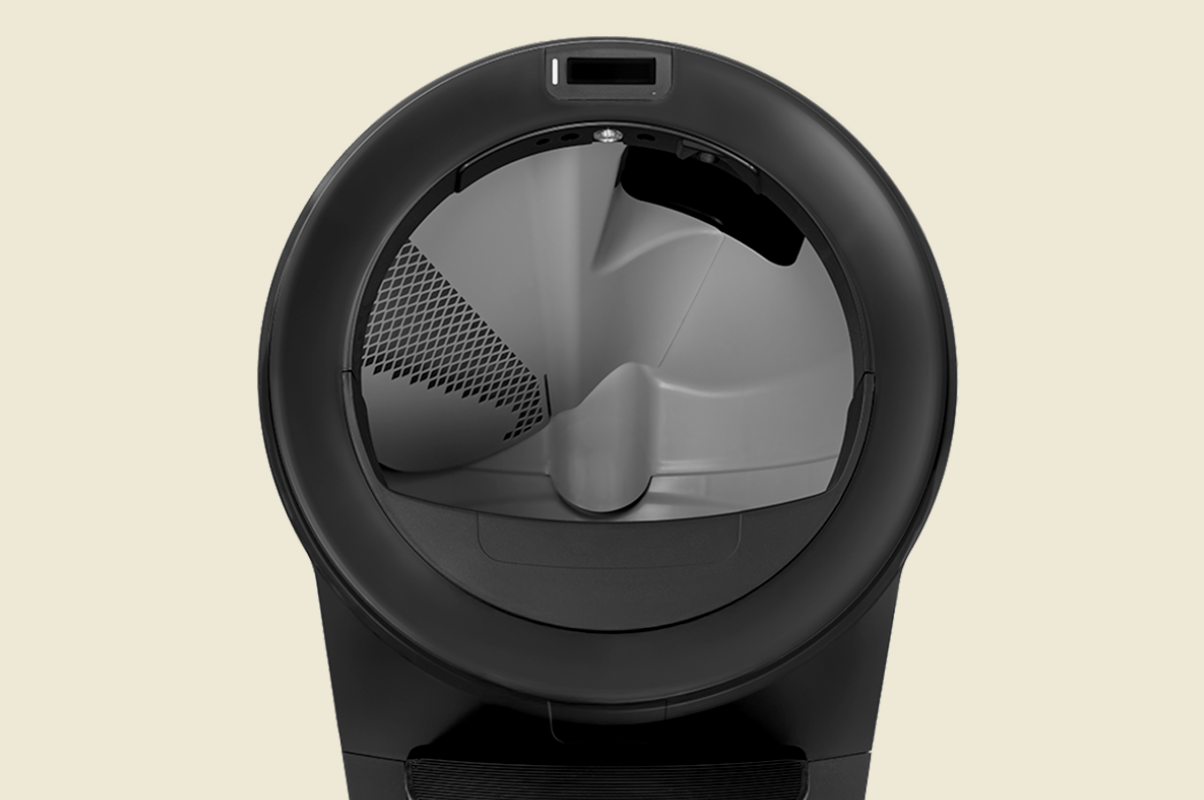
That platform expansion is most visible in Whisker’s most recent launch. In October 2025, the company introduced the Litter-Robot 5, 5 Pro, and EVO, alongside a new PetTag and a Whisker+ membership. The 5 Pro adds WasteID, technology the company describes as an industry first for distinguishing urine from feces for more targeted odor control and health tracking, plus dual AI-powered cameras that let owners stream and record their litter box in real time and use facial recognition to track up to five individual cats through the app. The EVO is a smaller, simpler unit aimed at apartment dwellers and first-time cat owners. The lineup expanded internationally into Canada in June 2026. It’s a shift in the pitch: Litter-Robot started as a convenience product that saved people from scooping, and it’s being repositioned as a health-monitoring device that happens to also clean itself.
Whisker is doing this inside a pet tech category that’s grown considerably around it — one market estimate puts the broader pet tech products segment at roughly $10 billion in 2026, on its way toward the mid-$20 billions by the early 2030s, with roughly ten companies controlling the majority of the smart-pet-product market. Zuppke has described the company’s approach to that competition in blunt terms: Whisker, he’s said, “built our iPhone before we built our Apple” — meaning Litter-Robot had to become the category-defining product on its own before the company could credibly stretch the Whisker name across feeders, litter, and other connected devices. That’s part of why the company has leaned hard on U.S. design and assembly and full control of its own supply chain rather than outsourcing manufacturing the way many competitors do.
In this episode, Jacob shares the grit of scaling without outside capital, how Whisker became a category-defining brand, and why the future of pet ownership is about more than just cleanup.
Listen to the full conversation with Jacob Zuppke on Apple Podcasts
Cameron Nagle is the founder and host of Starting Small, creator of the Starting Small Summit, and author of Starting Small: The Raw Truth About Entrepreneurship and the American Dream. About Cameron | Listen on Apple Podcasts